Imagine this: you’ve spent years crafting an 80,000-word PhD thesis. Now, you’re expected to condense that research into 3 minutes for the 3MT (Three Minute Thesis) competition. If you’re aiming for the VYT (Visualise Your Thesis) competition, you’ve got just 1 minute!
Turning an academic masterpiece – whether it’s an 80,000-word thesis or a 15,000-word confirmation of candidature – into a 1-3 minute performance isn’t just about simplifying; it’s about presenting your ideas in a tight, captivating art form.
For context on these tips, I’m nearing the end of my second year and have completed my confirmation of candidature and ethics approval. I’ve submitted a 15,000-word literature review and methodology framework, made changes based on external reviewers, and commenced a pilot study.
Tips from a first-timer for 3MT and VYT:
• Scripts and video planning: Creativity is key. Shorter is necessary. Review and edit obsessively. Read it aloud! I edited my VYT captions around 20 times, and my 3MT script even more. Align your captions with visuals and get a range of feedback.
• The Importance of Visuals: VYT allows flexibility (video, images, slides). One of the very early pieces of VYT feedback I got was on a slide where I say “now imagine that dog wagging its tail as the child reads aloud….” and to use a video of a kid reading to a dog while the tail wags. Cue 4hrs of attempting to film that! For 3MT, I will use a single evocative image—think minimalist.
• Title Changes: Use a snappy, descriptive title that grabs attention. Avoid your thesis title!
• The Hook: Avoid the overused “imagine that…” start in 3MT. Go for a fresh, engaging opening that situates the viewer in your research. Build connection and emotion.
• Jargon Be Gone: Simplify complex terms like pedagogy, emergent, fluency, phonemes for a general audience without being patronising.
• The Art of Storytelling: Use “I think…,” metaphors, similes, and rhetorical questions. Follow a story structure – start with a hook, provide details, and circle back to your opening.
• Significance: Explain why your research matters. Don’t overlook this, especially in the early stages. I missed it in my first drafts, as I’m in my second year with limited “output” yet.
Here is my V1 versus V6 script after sitting through lots of amazing training opportunities provided by my uni, including two extremely helpful sessions run by Simon Clews.
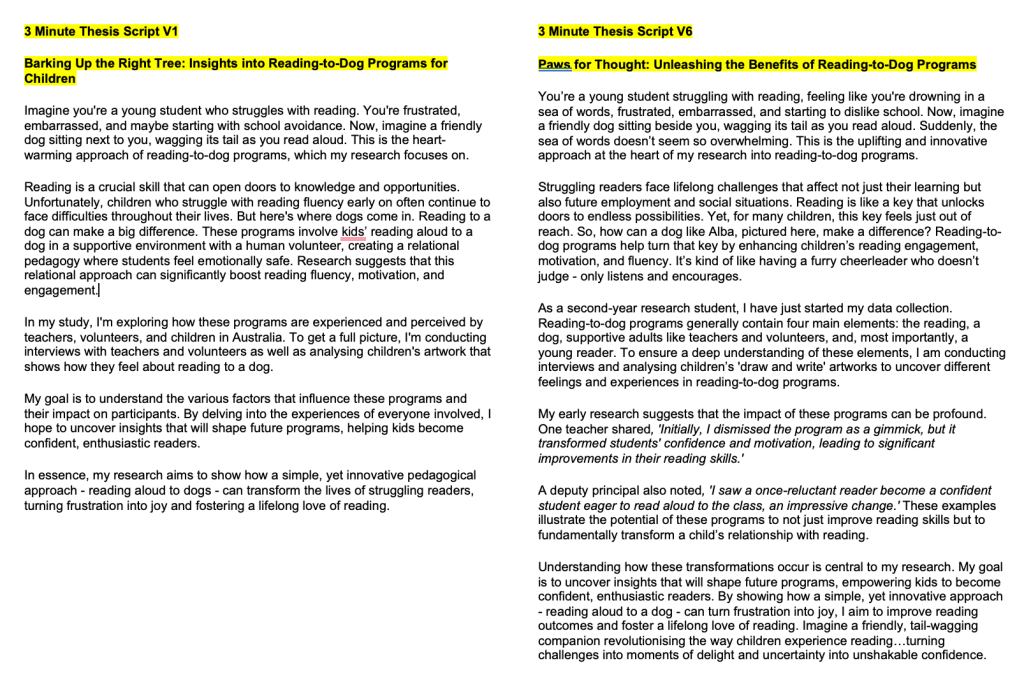
In short, distilling a thesis into an ‘elevator pitch’ is like condensing a complex recipe into a single bite-sized appetiser. It’s a challenge, but with the right approach, you can effectively capture the essence.

 Melissa Smith