At the start of my doctorate, everyone talked about the big things: research questions, ethics approvals, coding frameworks, findings chapters. But what helped me most? A GANTT chart and a stack of colour-coded sub-tasks.
This blog isn’t about “how to do a GANTT chart” (there are plenty of templates out there). It’s about why it’s worth doing and continuing to update it consistently….and why sub-tasks are the underrated heroes of getting your thesis done.
Big goals are great. But sub-tasks are how you move.
Saying “I’ll write Chapter 5” is kind of like saying “I’ll climb Mount Everest.” Sure, that’s the goal. But where do you start? What gear do you need? How do you know if you’re halfway?
Breaking each big task down – really down – helped me actually move. My GANTT chart includes things like:
• Organise and import transcripts
• Code a small sample and refine approach
• Revisit and add to researcher journal
• Identify illustrative quotes
• Conduct trustworthiness checks
Some of these took hours. Some took weeks. But none of them were as overwhelming as “do analysis.” And that made all the difference.
My example here shows you some of my subtasks in the last stages:
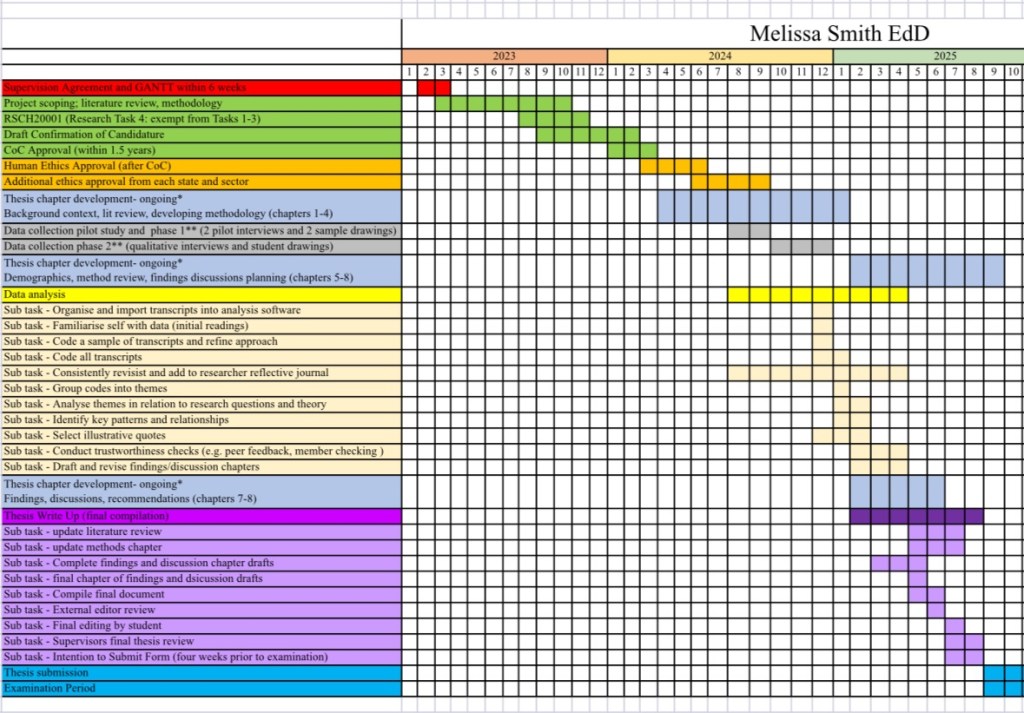
A visual plan gives you perspective (and proof of progress)
Research can feel endless. You can spend whole days thinking deeply and still have nothing “ticked off.” That’s where the GANTT chart helped. I colour-coded each phase of my research based on the initial example given by my school – ethics, data collection, analysis, writing – and could easily see how far I’d come.
It also helped in supervision meetings. Instead of saying “I think I’m behind,” I could say, “I’m in week 6 of this phase, and about halfway through my coding.”
Clarity, not confusion.
Sub-tasks are your best defence against burnout
There’s something oddly motivating about ticking off a task…even a small one. When I felt overwhelmed or stuck, I’d open my GANTT, pick a sub-task, and do it. Even on low-energy days, I could review transcripts or clean up quotes.
It wasn’t just about productivity. It was about momentum. And in a long-haul project like a thesis, momentum matters.
My advice? Start small. Get specific.
You don’t need to create a perfect GANTT chart at the start. I updated mine regularly as my project evolved. But having something to work from – and towards – kept me grounded.
If you’re early in your Masters of Doctorate or just about to start a major phase (like data analysis or writing up), take 30 minutes to break your big tasks into smaller ones. Then space them out. Give them colours. Print it out or keep it visible. Let it guide you.
Because in the end, a thesis isn’t written in chapters. It’s written in sub-tasks.

 Melissa Smith