The final stretch of a thesis is supposed to feel like the end is in sight… right?
But right now, it doesn’t. I’m in the thick of it. The last lot of feedback hit harder than I expected, and instead of motivating me, it’s left me frozen. I know it’s meant to strengthen my work…and it will…but it’s hard not to feel overwhelmed right now.
Balancing feedback, revisions, work, and life feels like spinning plates on a tightrope some days. It’s exhausting.
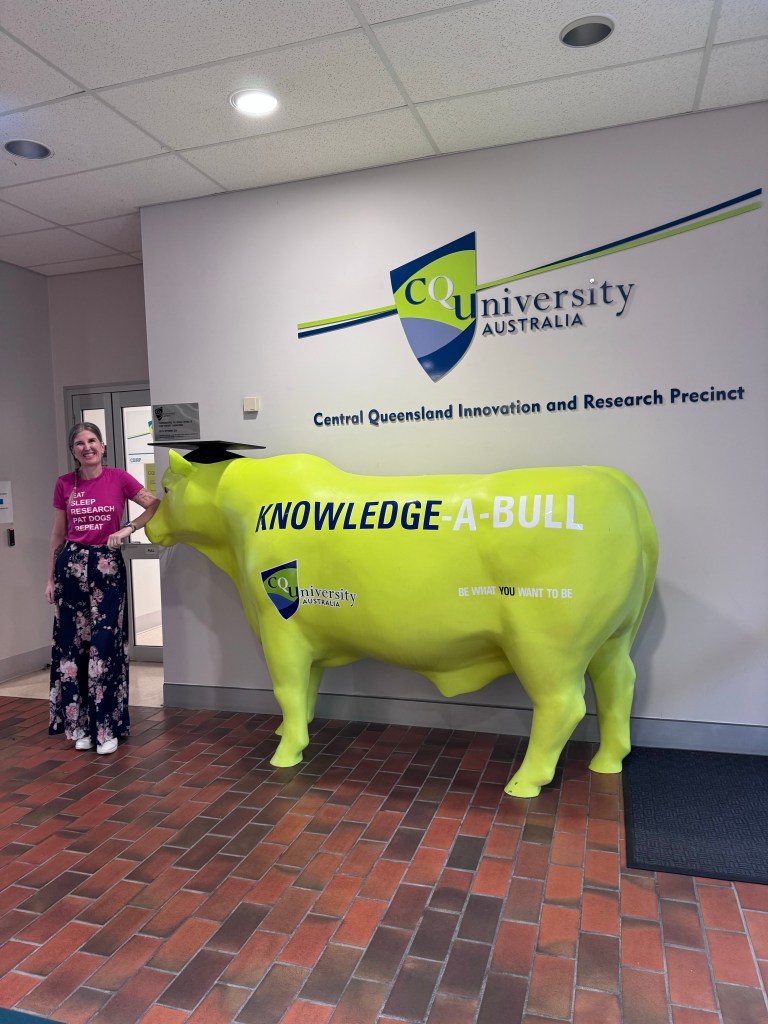
I’m sharing this not for sympathy but to remind others (and myself) that the final stages of a doctorate are tough. You’re not alone if you’re struggling. Sometimes “just keep going” looks like taking a break, admitting you’re stuck, or asking for help. Today, I asked for help and all the wonderful people I am lucky enough to be visiting in Rockhampton at CQUniversity rallied around.
If you’re also in the messy middle (or end) of a big project – academic or otherwise – I see you.
Let’s keep showing up, even if it’s just one word at a time.
Today I helped to run an activity for Murdoch Uni teaching staff based on the “world cafe” method. It was fantastic to see it in action, consider the modifications already made for accessibility and then discuss other things that could change. So many ideas!
The World Café is a structured conversational process for fostering participatory learning and knowledge sharing within large groups, where participants rotate through small-group discussions at different tables to explore various topics, share ideas, and build collective understanding. It’s designed to be a relaxed and informal yet purposeful method that encourages open dialogue, collaborative problem-solving, and the generation of collective intelligence. Using the large size butcher paper (or 2 x A3 sheets taped together) per table is a must to allow for larger writing spaces.
The cherry on top of my world cafe sundae was definitely how engaged all 45 people were!
I’ve seen a lot of online queries lately asking how people manage working part-time (or casually) while completing a PhD – and still have time for themselves. I thought it might be helpful to share what’s worked for me in one place.
Let’s be real: juggling academic work, a thesis, and a life isn’t easy. Here are some practical things that helped me stay sane(ish) and protect my weekends:
Containerised Browsing + Email Boundaries
I do a lot of casual academic teaching, which means I get emails at all hours from multiple employers and students. One of the best things I did was to use browser containers and schedule blocks to turn off those notifications when I’m focusing on my writing – vice versa. It took me way too long to put that boundary in place, but once I did, my ability to concentrate improved massively.
Saying No (Even When It’s Hard)
In my second year, I made the tough decision to leave an ongoing academic role, partly because the expectations just didn’t align with being part-time. I was constantly being contacted outside of hours and expected to jump in like I was full-time. Quitting was scary – hello job insecurity – but the improvement to my wellbeing was immediate and real. Sometimes you have to choose yourself.
Scheduling, with Wiggle Room
I use a shared calendar with my partner so we both know what’s happening and when….including non-negotiable downtime. I schedule my days with blocks, but I’m also realistic. I manage chronic pain, so if I have a crash day midweek, I’ll reshuffle things – maybe move a writing block to Sunday arvo. Flexibility within my desired structure has been key.
Communicating Crunch Times
When I’m in a crunch (like right now!), I let friends and family know. I still do my casual teaching work, but my writing schedule gets intense with tight deadlines. Being upfront means there are fewer expectations around spontaneous catch-ups or late-night dinner….and fewer guilty “sorry I can’t” texts from me.
No system is perfect, and things still fall through the cracks sometimes. But these strategies have helped me protect both my time and my energy. If you’re navigating the same mix of study, work, and life, I hope some of this is useful. And if you’re at the start of the doctoral level study I recommend you set those boundaries early. You’ll thank yourself later.
Let’s be honest: when you’re juggling teaching/work, research deadlines, writing, and the mental load of Research by Higher Degree (RHD) study, the idea of attending a conference social event might feel… expendable. It’s easy to convince yourself you’ll skip the welcome drinks or dinner, head back to the hotel, and catch up on work (or sleep). For someone like me who also manages chronic pain it can be even more tempting! There’s a lot of peopling at these events.
But here’s my advice: don’t.
Some of the most meaningful, memorable, and career-shaping moments happen after the formal sessions end.
On Day 1 at the National conference I am currently attending, I spent 10hrs on planes and in airports and arrived at the hotel just as the welcome reception started. Saying I was not in the mood was putting it lightly! But I went anyway and since I have no conference buddies here I wandered up to various groups to introduce myself. Lo and behold, I connected with someone who works at a uni I just applied for sessional work at! She took my card and assures me she has some casual work available next semester.
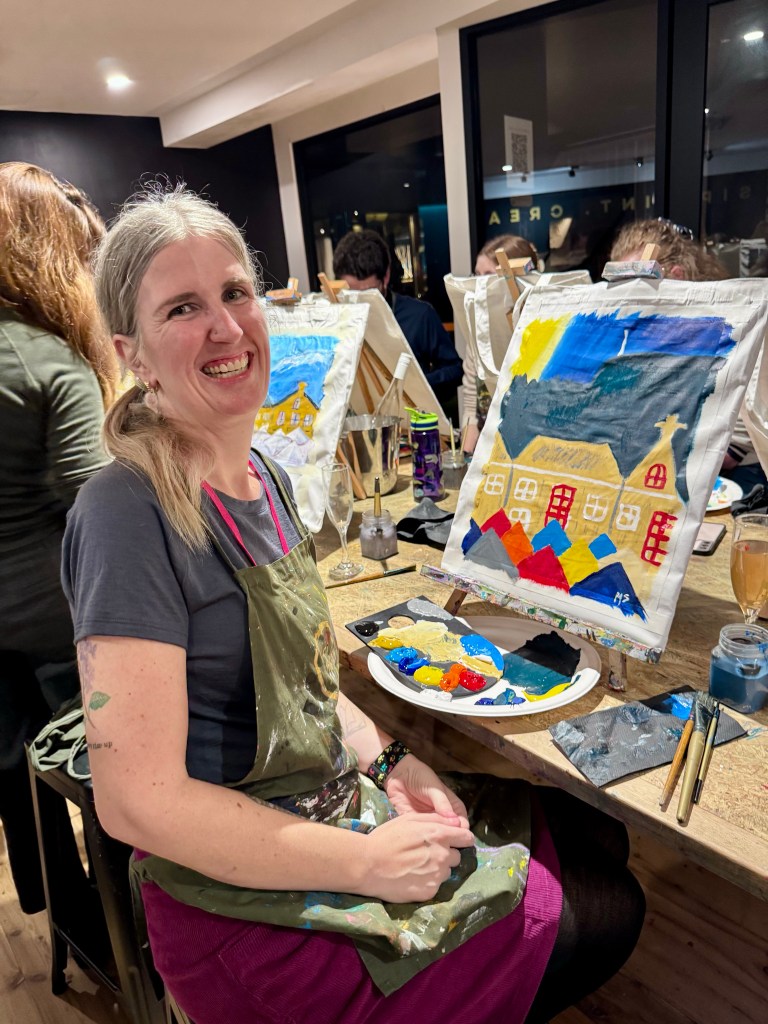
On Day 2, I found myself sitting between two lovely educators from different states while we painted at a “paint and sip” class. We weren’t dissecting theory or pedagogy or research – we were sharing stories about why we started in education, the messiness, and the many joys we see day-to-day. It was warm, real, and deeply validating.
Conference social events aren’t about networking in the cringey, corporate sense. They’re about connection. They’re where you meet the person who recommends a reading that reshapes your lit review. The person who’s trialled an idea you’ve only just begun exploring. The RHD student (or finisher!) who gets exactly what it feels like to be drowning in ethics forms, writing, editing etc.
Yes, you’ll be tired. Yes, it might feel awkward. But show up. You don’t need to stay all night. You don’t need to work the room. You just need to say hi, share a table, and let the conversation meander.
Because the magic of conferences isn’t always in the keynotes – it’s in the connections you carry home.
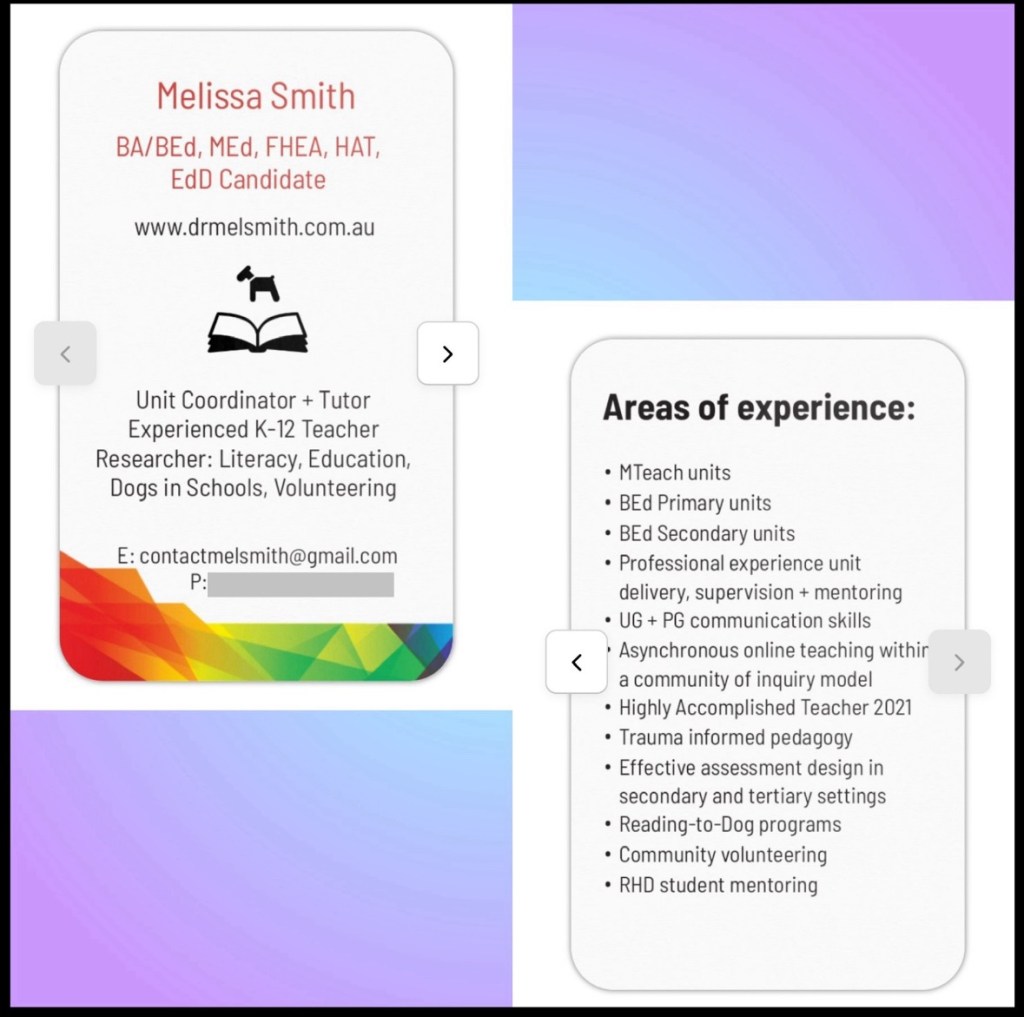
P.S. I’m a big advocate for business cards at these sorts of events. I know it’s considered a bit old school but something easy to carry you can hand to people is very useful. This is mine and while I do think it’s a bit cluttered, I give it out to a huge range of people so it needs to cover a bit! I made these on Vistaprint.
P.P.S I do just want to add a comment in here to conference organisers about ensuring conference social events are accessible. Lots of “conference dinners” seem to be shifting towards a cocktail style to reduce cost. I get it. But those events are not much fun for those of us using mobility aids or with invisible illnesses that make standing a challenge.
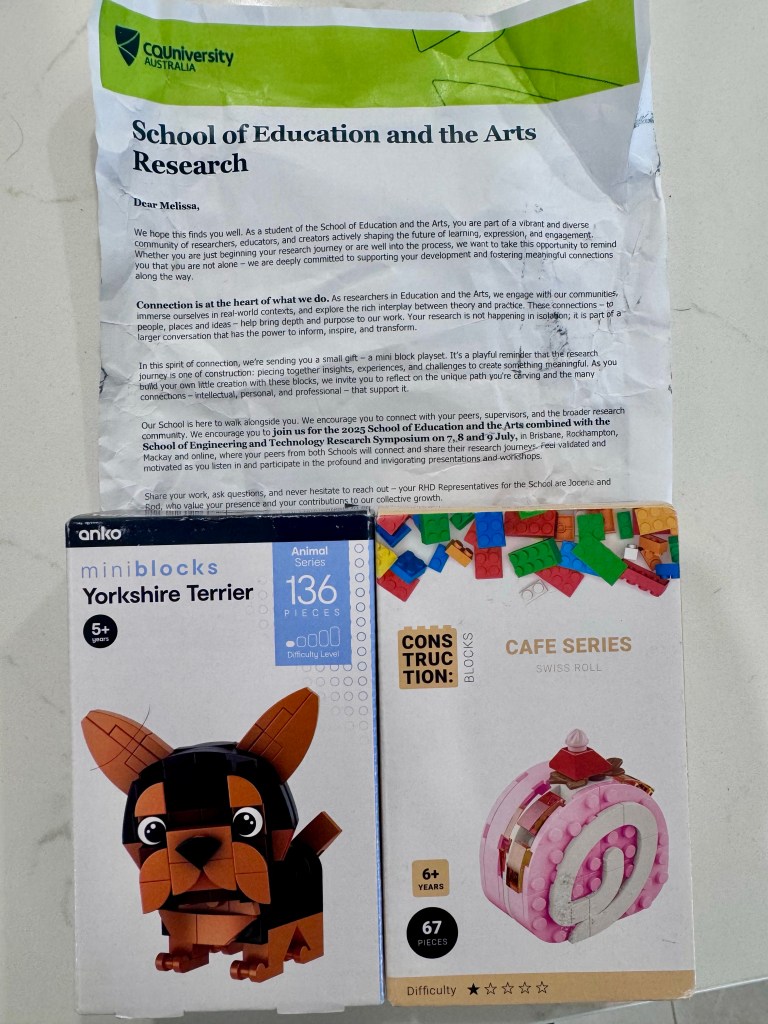
As an external doctoral student with CQUniversity’s School of Education and the Arts, I don’t always feel the buzz of campus life. But this week, that changed. I opened my mailbox to find a crinkled (but heartfelt!) letter from the research team – and two tiny, delightful surprises: a Yorkshire Terrier mini-block set and a snack based mini-block construction kit.
The letter invited me to the upcoming 2025 School of Education and the Arts Symposium, with a reminder that research is about connection and piecing together ideas and experiences to build something meaningful. The mini-block kits were a playful nod to that idea, encouraging us to take a breather and reflect on the process of building, in every sense.
I ask the important Qs though: like did someone at CQU know my doctoral research explores reading-to-dog programs?
Because… a Yorkshire Terrier mini-block kit seems more than a fluke!
Coincidence? Or the most adorably on-brand academic encouragement I’ve ever received?
Recently I’ve been supporting several students as they head towards the end of their thesis journey at my Australian Uni. I’m also at that stage and was asked about the proofreading process and budget allocation for this. Below are the points I wrote out specific to my own experience.
1. Talk to your supervisors and ask who they recommend. Often, they will have had a recent experience with someone (either positive or not so positive), so they can help to build a list with a few options
2. They have to be on the uni approved list. Can’t use them if not on the list.
3. It is important to plan ahead and know a month or two before you are aiming to send to proofreaders. They are often booked out right now, but will be able to allocate space to you in 6-8 weeks. This was how I got my first choice!
4. Contact them one at a time with an approximate word count and estimated date you will be sending it to them. Confirm they are available first. Then, ask them to send you a quote. The quote is based on word count and discipline so you will need to be able to give them a rougn word count idea for the quote. The cap for funding for proofreading is $1200 at my uni.
5. You can then send the quote to your School of Graduate Research and get it approved. You are encouraged to check your budget beforehand ito make sure you have the funds available.
6. When you submit your document to the proofreader, my supervisor also recommends completing the “intention to submit” form for SGR at that point. This is usually done 4-6 weeks beforehand.
At the start of my doctorate, everyone talked about the big things: research questions, ethics approvals, coding frameworks, findings chapters. But what helped me most? A GANTT chart and a stack of colour-coded sub-tasks.
This blog isn’t about “how to do a GANTT chart” (there are plenty of templates out there). It’s about why it’s worth doing and continuing to update it consistently….and why sub-tasks are the underrated heroes of getting your thesis done.
Big goals are great. But sub-tasks are how you move.
Saying “I’ll write Chapter 5” is kind of like saying “I’ll climb Mount Everest.” Sure, that’s the goal. But where do you start? What gear do you need? How do you know if you’re halfway?
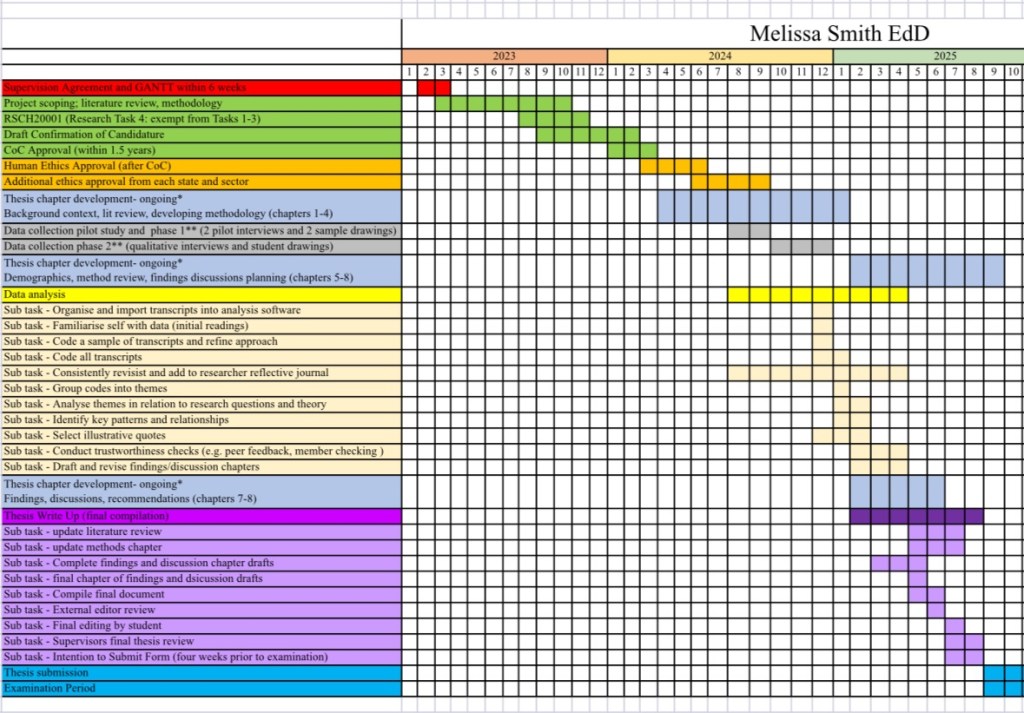
Breaking each big task down – really down – helped me actually move. My GANTT chart includes things like:
• Organise and import transcripts
• Code a small sample and refine approach
• Revisit and add to researcher journal
• Identify illustrative quotes
• Conduct trustworthiness checks
Some of these took hours. Some took weeks. But none of them were as overwhelming as “do analysis.” And that made all the difference.
My example here shows you some of my subtasks in the last stages:
A visual plan gives you perspective (and proof of progress)
Research can feel endless. You can spend whole days thinking deeply and still have nothing “ticked off.” That’s where the GANTT chart helped. I colour-coded each phase of my research based on the initial example given by my school – ethics, data collection, analysis, writing – and could easily see how far I’d come.
It also helped in supervision meetings. Instead of saying “I think I’m behind,” I could say, “I’m in week 6 of this phase, and about halfway through my coding.”
Clarity, not confusion.
Sub-tasks are your best defence against burnout
There’s something oddly motivating about ticking off a task…even a small one. When I felt overwhelmed or stuck, I’d open my GANTT, pick a sub-task, and do it. Even on low-energy days, I could review transcripts or clean up quotes.
It wasn’t just about productivity. It was about momentum. And in a long-haul project like a thesis, momentum matters.
My advice? Start small. Get specific.
You don’t need to create a perfect GANTT chart at the start. I updated mine regularly as my project evolved. But having something to work from – and towards – kept me grounded.
If you’re early in your Masters of Doctorate or just about to start a major phase (like data analysis or writing up), take 30 minutes to break your big tasks into smaller ones. Then space them out. Give them colours. Print it out or keep it visible. Let it guide you.
Because in the end, a thesis isn’t written in chapters. It’s written in sub-tasks.
I was reading responses today on a PhD forum around who people thanked in their thesis acknowledgement/personal thank you section.
Some were very simple (committee, god, family) and others were much more extensive. One person even had none!
I’m a few months off that stage now so it’s been on my mind recently. My list is lengthy because my journey hasn’t been straight forward:
My husband
Supervisors. I have been so lucky to have amazing supervisors
My dogs (my research is animal based and my doggies started me on it and kept me company while writing)
The many teacher and uni colleagues l’ve worked with who supported me emotionally and practically as I hit speed bump after speed bump
The many people who voluntarily helped out with my research for no personal gain, including numerous volunteers in the community who gave so much of their time. They saved my bacon a few times when I had ethics issues trying to go into schools
My besties who listened to me complain a lot. Like….a lot!
My family, especially my grandparents. My 97yo grandad has drawn me a dog themed illustration for each chapter so his illustrations will live on forever.
I’m also currently considering adding my recliner which has supported me through most of my writing.
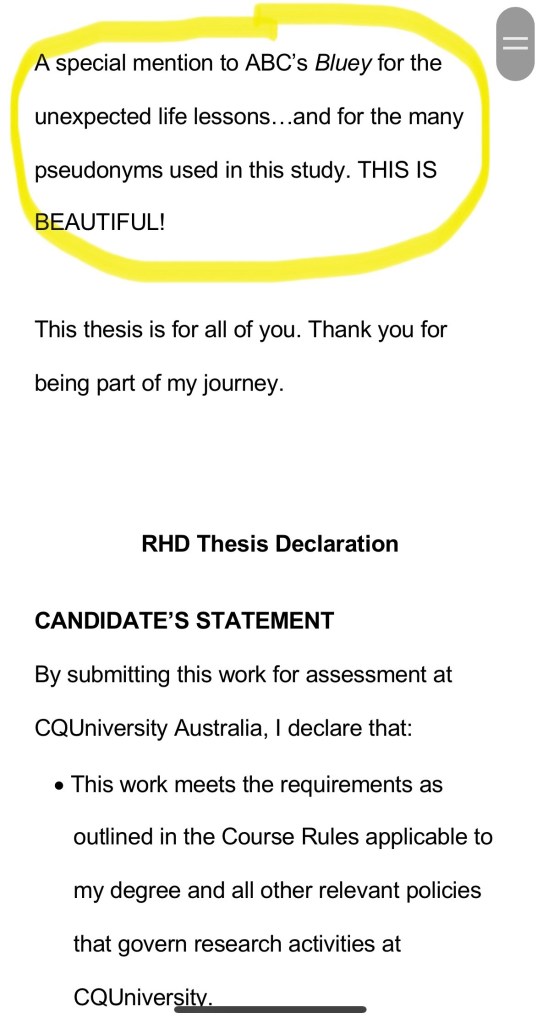
And finally….most importantly….Bluey gets a mention!
I’m a teacher. I’m used to guiding, explaining, facilitating. So when I started interviewing volunteers, I brought that with me.
But reflexive interviewing, I learned, is not about guiding. It’s about holding space.
I added a final question to every interview:
“Is there anything else you’d like to share?”
That one question changed things.
So many rich, unplanned insights came in response to that. Stories that reshaped themes, exposed contradictions, or brought forward emotion that earlier answers hadn’t touched.
And often, those insights came after a long pause.
Silence used to make me uncomfortable. Now I understand it as part of the data. Holding space isn’t passive – it’s deeply active. And sometimes, it’s where the best stuff lives.
Here’s something I didn’t expect in my data collection: how hard it would be to get online with participants.
Many of the volunteers in my study weren’t tech-savvy. Teams links didn’t open. Emails got missed. One participant dropped out because she couldn’t figure out how to turn her camera on.
These weren’t “difficult participants.” They were generous people navigating tools that weren’t designed with them in mind.
Eventually, I simplified everything:
• Switched to digital signatures
• Created a youcanbook.me calendar with automatic reminders and an easy scheduling tool to avoid back and forth
• Always had a phone backup ready
Reflexive research isn’t just about epistemology. It’s about logistics, empathy, and meeting people where they are. That’s part of being ethical, too.
 Melissa Smith