I expected my data to show volunteers feeling rewarded and impactful. And many did. But then a few started saying things like:
“I’m not sure it made any difference.”
And I froze.
My instinct was to treat those comments as outliers. But I kept hearing them. And eventually I had to ask: what’s being revealed here that I don’t want to see?
Reflexive thematic analysis reminded me that disconfirming evidence isn’t a disruption—it’s a gift. It pushes you to deepen, expand, and challenge your early assumptions.
So I created a new code: ‘volunteer uncertainty’. And it changed how I saw the entire landscape of my findings.
Don’t ignore what makes you uncomfortable. That’s where the meaning often sits.
I used to think coding was clean. Apply a label, sort the data, move on. Then I started actually coding for reflexive thematic analysis.
Suddenly I found myself staring at a phrase like “She seemed more relaxed” and asking: is this a semantic code? Or am I interpreting too much? Is this about child confidence… or am I just hoping it is?
Reflexive thematic analysis invites us to sit with that mess. Braun & Clarke don’t ask for perfect distinctions – they ask us to be reflexive about our role in making meaning.
So I started keeping a “murky codes” list – entries I wasn’t sure about, to revisit later. Some became strong latent themes. Some I dropped. But the point was, I thought through my decisions, rather than pushing uncertainty aside.
Reflexivity isn’t just about the emotional stuff. It’s about being honest when your analysis isn’t clean and knowing that’s not a flaw, it’s the work.
When I first started writing up my findings, I thought vignettes were just nice narrative touches…something to make the data “come alive.” But as I worked through my reflexive thematic analysis, I realised they were doing much more.
Vignettes became tools for meaning-making.
Rather than dropping in quotes to support a point, I began stitching together multiple data sources – interview excerpts, field notes, pauses, body language – to build short, situated vignettes that captured complex moments. This helped me show nuance, not just tell it.
Braun & Clarke remind us that theme development is interpretive. For me, vignettes helped carry that interpretation in a grounded, layered, and human way.
One tip? Don’t treat vignettes like sidebars. Build them into your themes. Let them do analytical work.
I’m using reflexive thematic analysis as outlined by Braun & Clarke, which makes room for subjectivity – not just as something to “manage,” but as a central part of meaning-making. That means your values, experiences, and responses matter and should be visible in your process.
For me, journaling wasn’t just about transparency for the sake of a future methodology chapter. It helped me:
• Track how my thinking changed over time
• Record doubts, questions, and decisions so I could revisit them
• Notice emotional responses I might have brushed off
• Stay connected to the humanity of my participants
In short, it helped me be a better, more self-aware researcher.
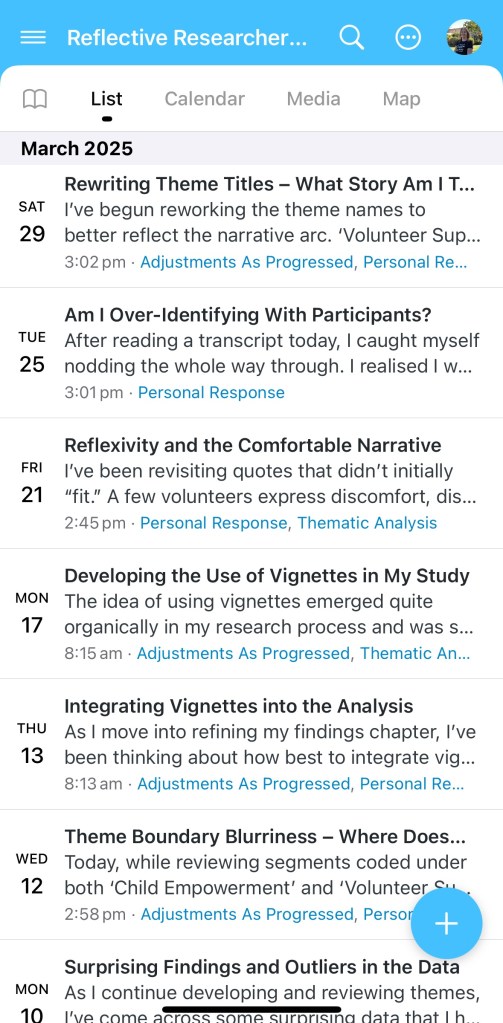
Why I Chose Day One as My Journaling Tool
First of all, I paid full price for Day One on apples App Store and was in no way gifted or sponsored anything for this. I did start with apples free journaling tool which may also work for you.
I wanted a digital journal that was:
• Easy to access across devices (I could journal straight after interviews on my phone, or type up a longer reflection on my laptop…or access things from my iPad during supervisor meetings)
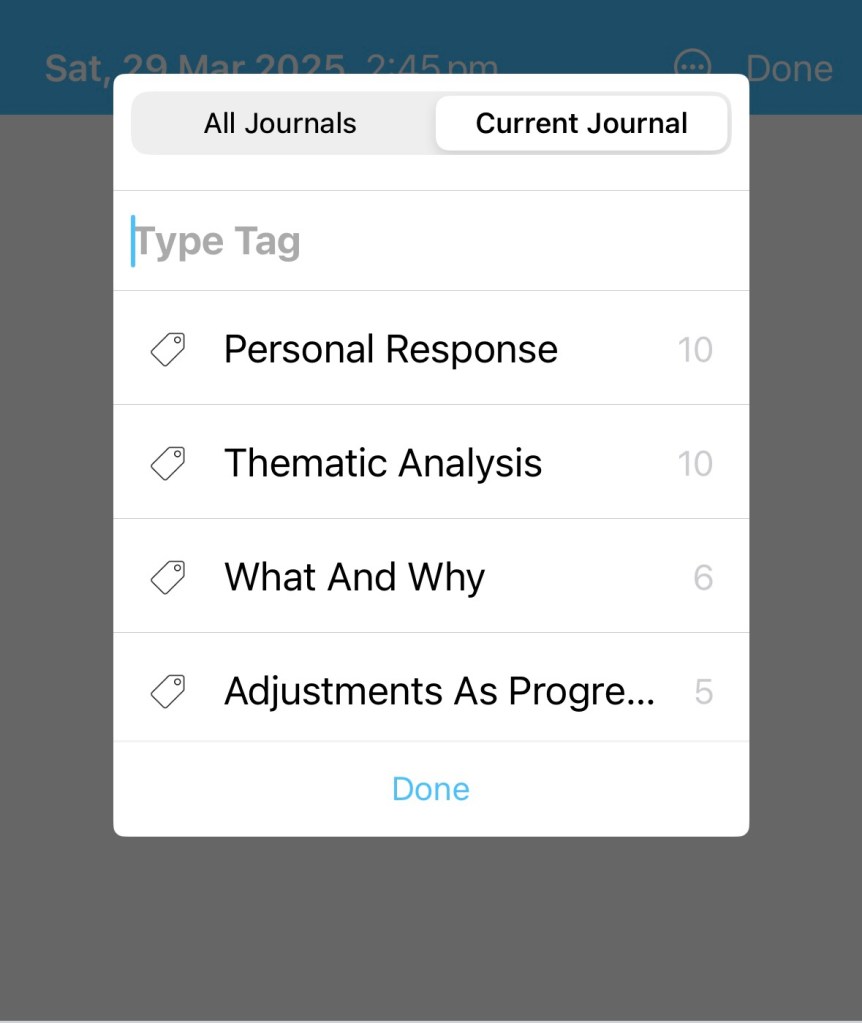
• Searchable and taggable (so I could find entries linked to certain interviews, moments, or themes). This was the biggest downside to the Apple free one as they simply did not have it and the tags were really important for me
• Flexible (I could insert screenshots of coded segments, voice memos, or links to articles I was thinking about)
Day One ticked all those boxes. It also has a really clean, distraction-free interface, which meant I actually used it.
What I Wrote About (with Real Examples)
I didn’t use a rigid structure, but over time, a few types of entries emerged:
• Post-interview reflections: What stood out? What surprised me? What emotional responses did I have? Did anything feel hard to hear or hard to believe?
• Coding notes: After a coding session, I’d jot down what I found challenging or energising. Sometimes I’d question myself: “Am I forcing this theme because I want it to be there?”
• Theme development entries: When a theme was forming or changing, I’d write about how it emerged and why I thought it mattered. These entries were messy and full of “maybe it’s actually about…” moments.
• Supervisor meetings: I’d quickly record what we discussed, what I felt unsure about, and what I was excited to try next. This helped track how our conversations shaped the project.
• Messy feelings: I wrote entries like “I’m worried this isn’t interesting enough,” or “I think I’m over-identifying with this participant.” These were often the most useful entries when it came to writing my reflexivity section.
How Often I Journaled
This varied depending on the phase of research. Roughly:
• After each interview (within 24 hours)
• After each major coding session
• Anytime I felt stuck or had a strong reaction
• After supervision meetings
• When something shifted in my thinking
I didn’t force myself to write every day. But I did treat journaling as an essential part of the research, not an “extra.” I’d often set a timer for 10 minutes and just see what came out.
Prompts I Used (or Wrote to Myself)
These were a mix of pre-planned and spontaneous:
• What assumptions am I bringing today?
• What is sitting uncomfortably with me?
• What did I want to find, and did I find it?
• What voices or perspectives am I ignoring here?
• Is this theme emerging from the data…or from me?
• What’s changed in how I see this topic since I started?
Sometimes I just started typing: I don’t know what to write but I feel like something’s shifted…
What I’d Do Differently Next Time
Looking back, a few things I’d improve:
• Be more consistent in tagging entries by theme, stage, or emotional tone
• Include more screenshots from my coding software (NVivo) to link journaling directly with data
• Write the messy stuff sooner, I often waited until I had a “neat” insight, but the raw uncertainty was just as valuable
• Schedule regular reflection time into my week, not just when things felt intense
Why This Helped So Much
Journaling helped me stay accountable to my values. It reminded me that I wasn’t trying to be an objective robot sifting through words…I was a human, engaging deeply with other humans’ stories.
It also gave me material I later used in my methodology and discussion chapters. I could literally quote past entries that showed how my themes emerged, or how I wrestled with a particular coding decision.
More than anything, it was a space to think. Not to prove anything, just to notice, reflect, and stay open.
Final Thoughts
If you’re doing qualitative research and have been told to “keep a reflexive journal,” I hope this helped lift the veil a little. You don’t have to write perfect, poetic entries. You don’t have to journal daily. You just have to show up with honesty and curiosity – and find a method that helps you track your learning as you go.
Day One worked for me. Maybe a notebook, Word doc, or voice memo app will work for you.
Whatever you choose, just start. The messy thoughts are often the most meaningful.
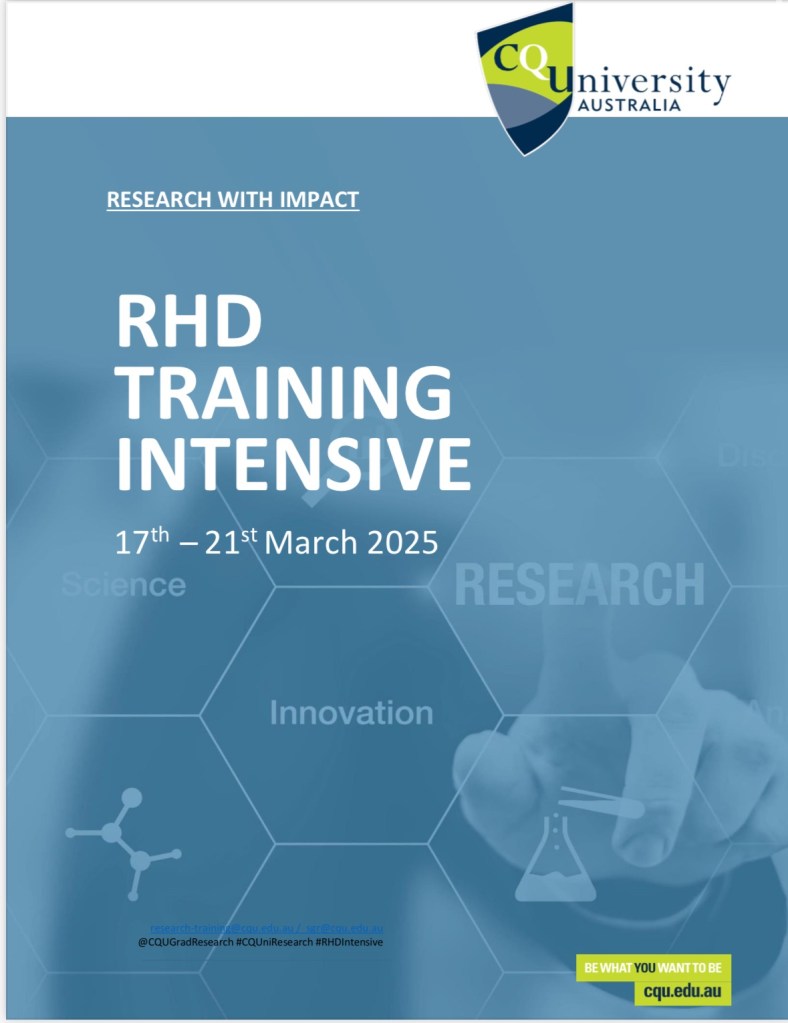
This week, I’ve been lucky enough to attend the Pre-Confirmation of Candidature Research Higher Degree (RHD) Training Intensive at CQUniversity Rockhampton – not just as a researcher, but as an RHD Mentor.
It’s once again been an incredible experience connecting with early-stage researchers, offering guidance, and witnessing the energy and dedication they bring to their projects. The program is packed with skill-building sessions, networking opportunities, and invaluable insights from experienced academics and peers.
One of the best parts? The sense of community. Research can sometimes feel isolating, but events like this remind us that we’re part of a broader network of scholars who support and challenge each other. Whether it’s refining research questions, planning literature reviews, tackling methodology, or just sharing the ups and downs of the RHD journey, these conversations are what make the experience so rewarding.
To those considering attending in the future – do it. A huge shoutout to the CQUniversity SGR team who made this week such a success!
I haven’t taken many photos this time around but this is myself and one of my fellow RHD mentors enjoying a well earned wine at one of the group dinners.
I’ve been accepted into the Thesis Completion Initiave (TCI) at CQUniversity!
TCI offers RHD candidates the chance to re-direct unused funding from their RHD budgets to support their thesis drafting. More importantly, it is a writing support program, aimed at providing candidates of all disciplines with peer support, motivational support and tips on writing productively. The typical structure of sessions is time spent discussing each participant’s progress towards their thesis goals; sharing successes and challenges; and supporting one another with potential solutions to common problems such as writer’s block, lack of motivation, managing time and other concerns. We then goal set and revisit those goals in the next session.
As an online/external student it can be a bit lonely….and overwhelming when writing things like findings and discussion chapters for the first time! So I’m excited to have some accountabil-a-buddies to keep me focused and positive.
Written by Melissa Smith, Doctor of Education student (teacher for 18 years), Central Queensland University
I’ve always believed that the most meaningful educational programs often have a spark of creativity – the kind that lights up students’ eyes and makes learning feel less like work and more like an exciting discovery.
My grandad is 97 years old and one of my favourite people. He keeps telling me my thesis publication is too far away for him! So, I asked if he would like to draw some doggy line drawings I could add to each chapter. He’s taken to the task with gusto and I love them so far.
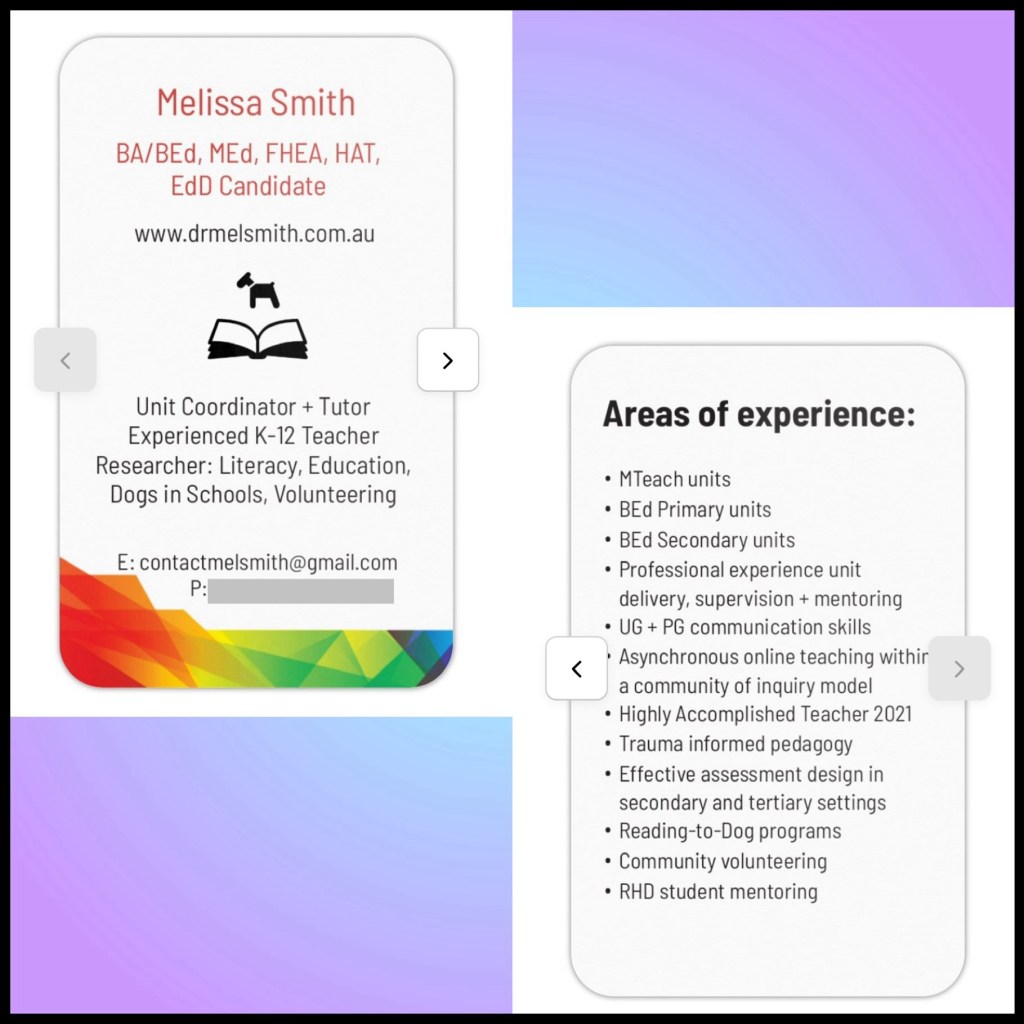
Another fantastic session during the CQUniversity RHD Online Intensive with Maria Gardiner today. The conversations inspired me to update my (very cheap Vistaprint) business cards to include a few recent achievements and ensure they are more “me”.
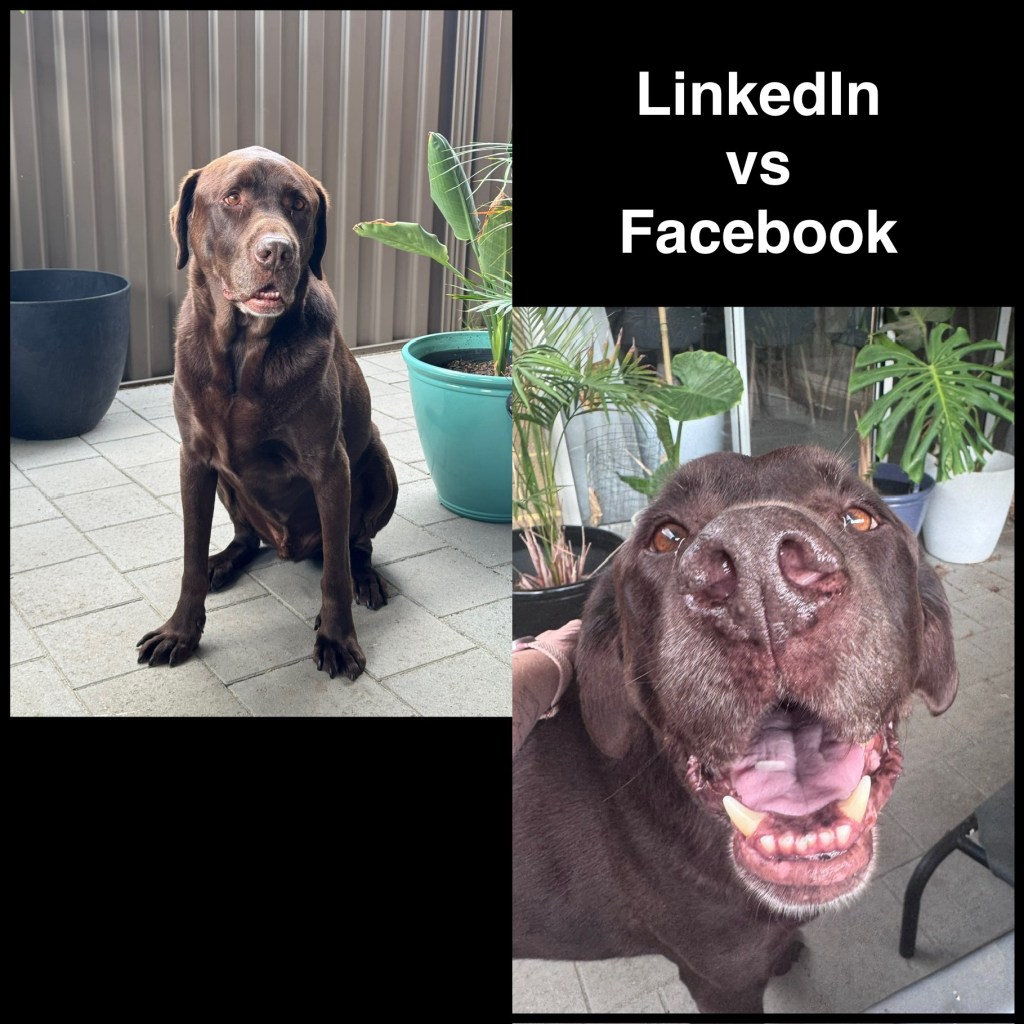
We also spoke about the importance of LinkedIn these days, google scholar (which I need to explore) and things like this website and blog. In fact, Maria used this as an example of what to do which was a bit exciting for me!




 Melissa Smith